EVgo Fast EV Charging Stations
- 4.6
- Rating
- 1.00M
- Installs
- Free
- Price

 Analysis by App-foxy
I came away from EVgo Fast EV Charging Stations with a fairly clear impression: it is most useful when charging is part of a journey rather than a quick afterthought. The app is built for finding and using EVgo’s fast-charging network, and that focus makes it more practical than a general map when I am already driving an electric car and need to make a charging decision.
EVgo is a free Auto & Vehicles app developed by EVgo. It has reached more than a million installs and holds a 4.5 average from roughly nine thousand ratings, which suggests that it has become a familiar tool for many EV drivers. I would not describe it as a complete replacement for every navigation or vehicle app, but I do see it as a useful specialist companion, especially for people who regularly depend on public fast charging.
How the app fits into a real charging routine
My preferred way to use an app like this is before I actually need it. When the battery is getting low, I want to know where the next suitable charger is, whether the location fits my route, and whether stopping there makes sense compared with continuing farther. EVgo’s main value is putting that charging search in one dedicated place instead of making me sort through unrelated map results.
You May Also Like

 Blood Strike: 2.5 Anniversary
Blood Strike’s Loadouts Turn Every Drop Into a Tactical Gamble
A close look at Blood Strike’s custom loadouts: how fast access to signature weapons reshapes its battle royale rhythm, rewards preparation, and narrows the gap between fights.

 Pandora - Music & Podcasts
Pandora’s Music Is Easy to Start, but Harder to Recover
Pandora’s strength is its low-effort path from a seed to a station. Its weak spot is how much confidence it asks you to place in connection, setup, and quiet recovery.

 8 Ball Pool
 Is Built on Rivalries, Rematches, and Routine
A close look at the rivalries, rematches, shared routines, and unanswered safety questions that turn a quick pool match into a persistent mobile community.

 Samsung Music
’s Quiet Strength Is Playing What You Already Own
Its reach comes less from spectacle than from dependable access to a personal library. That simplicity is both the app’s strongest retention engine and its ceiling.

 AccuWeather: Weather Radar
AccuWeather Review: A Quick, Clear Forecast for Everyday Decisions
For everyday plans, the best forecast is the one you can understand quickly. AccuWeather makes rain timing, radar, and local conditions easy to act on, with a few trade-offs.

 Hill Climb Racing
Why Hill Climb Racing Still Turns Crashes Into One More Run
A tiny car, a bumpy hill and one more upgrade: Hill Climb Racing keeps resurfacing because its simple chaos makes every near-miss feel personal.
More From Our News Desk



The distinction matters on a road trip. A normal maps app may show charging locations, but a charging-focused app keeps the decision centered on the vehicle, the network, and the stop itself. I can begin with the route, inspect nearby EVgo fast-charging stations, and decide whether to stop now or preserve enough range for another option. That is a more deliberate workflow than simply searching for “charger” and choosing the first result.
A realistic example is an evening drive after work. I might leave with less battery than expected, notice traffic building, and decide that waiting until the destination is risky. In that situation, opening EVgo while parked lets me look for a station along the remaining journey rather than improvising at the last minute. The app is most helpful when it turns a vague concern—“Will I make it?”—into a concrete charging stop.
I also like the fact that the app has a narrow purpose. There is less temptation to treat it as a general travel planner. For an EV driver, that can reduce mental clutter: the car’s own system may handle range estimates and route guidance, while EVgo handles the network-specific charging task. That division of labor is sensible, although it means I still need another navigation tool or the vehicle’s built-in system for the broader journey.
What I found most useful during planning
The strongest part of the experience is the station-first perspective. Instead of thinking only about distance, I can think about where a charging stop belongs in the journey. That is an important difference. The nearest station is not automatically the best one if it sends me away from the route, creates an awkward detour, or leaves me searching again later.
I recommend checking a station before leaving, not only when the battery warning appears. This gives me time to compare nearby choices and notice whether the stop is positioned conveniently for the trip. It also reduces the risk of making a rushed decision while driving. I treat the app as a planning aid, not something to operate continuously behind the wheel.
Another useful habit is to keep the app alongside the car’s range display rather than trusting either one in isolation. The vehicle tells me what the battery estimate looks like; EVgo helps me identify a charging destination. Weather, speed, hills, traffic, and heating or cooling can all affect the practical range, so I prefer leaving a buffer instead of planning around the last possible percentage.
This is one of the less obvious strengths of a dedicated charging app: it encourages a different mindset. I am not merely looking for a pin on a map. I am deciding when to stop, how much flexibility I need, and whether a fast charger is worth using for this particular leg. That makes the app more valuable for repeated travel than for a single emergency search.
Where it compares well with ordinary alternatives
Compared with a general mapping app, EVgo feels more focused. A map application is excellent for directions, traffic, restaurants, and broad location searches, but charging information can become just one layer among many. EVgo’s advantage is that charging remains the central task. If I already know I want an EVgo station, starting here is more direct than filtering a large map.
Compared with relying only on the vehicle’s built-in navigation, the app can be a useful second opinion. The car may be better for turn-by-turn guidance and battery-aware routing, while the EVgo app is better suited to checking the network I intend to use. I would not force one tool to do the other’s job. The best setup is often the car for driving instructions and EVgo for station research.
There is also a practical difference between a network-specific app and a broad charging directory. A directory can be helpful when I want to compare many operators, but it may feel excessive when my immediate plan is to use EVgo. This app is a better fit for a driver who already has a reason to look within that network. Someone who wants every possible charging provider in one search may prefer a broader tool as the starting point.
That trade-off is important. EVgo’s focus makes it easier to make a network-specific decision, but it does not eliminate the need to think about alternatives. On unfamiliar routes, I would still check the wider charging landscape if the next EVgo stop is inconvenient or if I want a backup plan. A specialist tool can be efficient without being the only tool I need.
The friction I would want new users to understand
The main limitation is that a charging app cannot remove the uncertainty of public charging. Finding a station is only one part of the experience. The stop still has to fit the route, the vehicle, the timing, and the driver’s tolerance for waiting. I would not open EVgo expecting it to guarantee a perfectly effortless journey every time.
There is also a planning burden that remains with me. I need to choose a sensible stopping point, allow for range variation, and avoid treating the displayed location as an invitation to arrive with no reserve. A first-time EV owner may expect the app to make the entire decision automatically. In my experience, it is more useful as a clear reference than as a substitute for judgment.
The network-specific design can become a weakness when I am traveling through an area where another operator would be more convenient. If I were comparing all available charging networks, I would use a broader charging service or the vehicle’s navigation as well. EVgo is not the right first choice for someone who wants one universal directory and has no preference about the operator.
I would also avoid making a last-second stop search while moving. Even a well-designed app is distracting if handled at the wrong time. My practical routine is to search before departure, while parked, or with a passenger handling the phone. That small change makes the app much more useful and keeps the charging decision separate from the driving itself.
Who will get the most from it
I think this app is best for EV owners who frequently use public fast charging and want a dedicated way to plan around EVgo locations. It should appeal to commuters without reliable home charging, apartment residents, road-trippers, and drivers whose daily routes regularly extend beyond their comfortable battery range.
It is also a sensible choice for someone new to electric driving who wants a straightforward place to begin learning public charging habits. The app’s free price lowers the barrier to trying it, and its Everyone content rating makes it suitable for a broad audience. The current version is 26.3.1, and it supports devices running Android 8.0 or later, so compatibility is worth checking before installation on an older phone.
I would be more cautious about recommending it to a driver who charges almost exclusively at home. If public charging is rare, a built-in car system or a general map may already cover the occasional search. Likewise, drivers who regularly cross several charging networks may find a multi-network tool more convenient because it keeps alternatives visible from the start.
The app makes particular sense when charging decisions repeat. A single holiday trip can justify using it, but its real value appears when I develop a routine: checking a station before a long drive, identifying a backup, and learning which stops fit my usual routes. That repeated use is where a dedicated network app earns its place on the phone.
Small workflow changes that improve the experience
My first tip is to plan the stop around the journey, not around the charger alone. I look for a location that does not create an unnecessary detour and that leaves me enough range to adjust if the trip changes. This sounds simple, but it prevents the common mistake of choosing the closest pin without considering what happens afterward.
My second tip is to make a backup decision before setting off. I do not need a long list of alternatives; one reasonable second option is often enough. If traffic, range loss, or an unexpected delay changes the plan, I would rather already know the next place to check than begin searching from scratch with a low battery.
My third tip is to use the app as part of a two-screen mental model, even if I only have one phone. The vehicle’s display answers questions about current range and driving conditions, while EVgo answers the network question. Keeping those roles separate helps me avoid confusing a promising station location with a complete route plan.
A fourth useful habit is reviewing the route before the battery becomes critical. Public charging works better when I have choices. Waiting until the final stretch can turn a convenient fast-charge stop into a stressful detour, particularly if the journey is unfamiliar. EVgo is more effective when I use it early enough to make a calm decision.
What the adoption numbers suggest, without overstating them
The app has accumulated around nine thousand ratings and about three thousand written reviews, with a 4.5 average. I take that as encouraging evidence that the basic experience works well for a substantial group of drivers, but I would not treat the rating as a guarantee for every route or vehicle.
Its reach is also notable: more than a million people have installed it. That level of adoption makes it feel like an established tool rather than an experiment, especially for drivers already interested in EVgo’s network. Still, personal usefulness depends more on where I drive and how often I need public fast charging than on the install figure.
The free price is another practical advantage. I can try the app without making it a financial commitment, then decide whether its network-specific approach matches my habits. For me, that makes the decision straightforward: install it if EVgo stations matter on my routes, but keep a broader option available if I often compare operators.
My final recommendation
After looking at the app as a daily travel tool rather than just a station finder, I see EVgo Fast EV Charging Stations as a focused and worthwhile companion for public EV charging. Its best quality is clarity: when I want to plan around EVgo fast chargers, it keeps that task in front of me instead of burying it inside a general-purpose map.
The limitations are equally clear. It is not a universal charging directory, it does not replace vehicle navigation, and it cannot make range planning or public charging completely predictable. Drivers who rarely use public chargers may not need a dedicated network app, while frequent travelers across multiple operators should compare broader alternatives too.
For the right driver, though, the balance is good. I would recommend EVgo Fast EV Charging Stations to anyone who regularly needs public fast charging, especially if EVgo stations appear along familiar commutes or longer routes. My strongest advice is to use it before the battery becomes urgent, pair it with the car’s own range information, and keep one backup option in mind. Used that way, EVgo is less a simple map and more a practical part of a calmer EV travel routine.
FAQs for EVgo Fast EV Charging Stations
01What is EVgo Fast EV Charging Stations app?
The EVgo Fast EV Charging Stations app is designed to help electric vehicle owners locate and access EVgo charging stations nationwide. It provides real-time information on station availability, charging speeds, and pricing. Users can also initiate and track their charging sessions directly through the app.
02How do I find an EVgo charging station using the app?
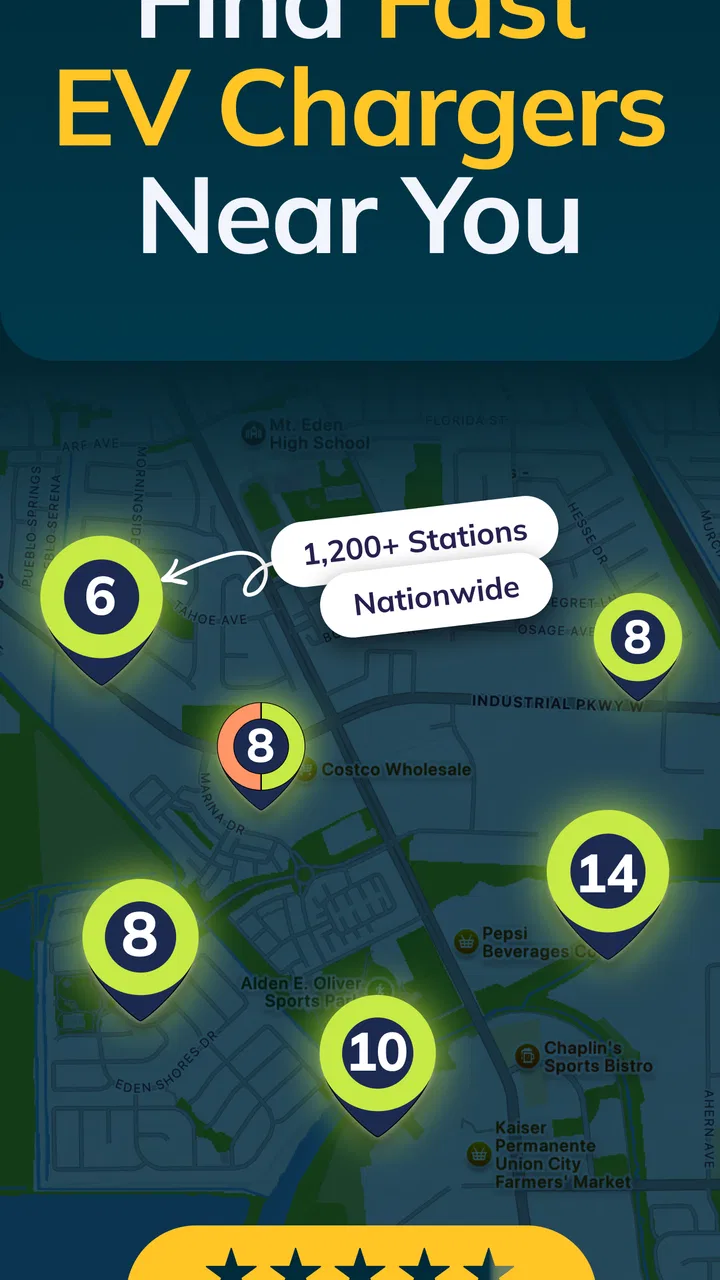
The app includes a user-friendly map feature that displays all nearby EVgo charging stations. Users can filter results by charging speed, connector type, and availability. Simply enter your location or allow the app to use your GPS for personalized results, ensuring you find the most convenient station.
03Can I start a charging session through the EVgo app?
Yes, the EVgo app allows users to start and stop charging sessions directly from their smartphones. Once you arrive at a station, select the charger in the app and follow the on-screen instructions to begin charging. This seamless process eliminates the need for physical cards or additional authentication.
04Is there a subscription fee for using the EVgo app?
Downloading the EVgo app is free, and there is no subscription fee for using its basic features. However, charging fees apply when using EVgo stations. The app provides detailed pricing information for each station, and users can choose from various payment options, including pay-as-you-go or membership plans.
05How does the app help manage charging costs?
The EVgo app provides users with transparent pricing and allows them to track their charging costs in real time. It offers detailed session history and receipts, helping users budget their electric vehicle expenses effectively. Additionally, users can compare costs between different stations to find the best rates.
Pros
- Wide network of charging stations
- Easy-to-use mobile app interface
- Real-time station availability updates
- Supports multiple EV models
- Offers contactless payment options
Cons
- Limited rural area coverage
- Occasional app connectivity issues
- Higher costs compared to home charging
- Some stations may have maintenance delays
- Limited charging speeds at busy times

EVgo Fast EV Charging Stations
Gallery